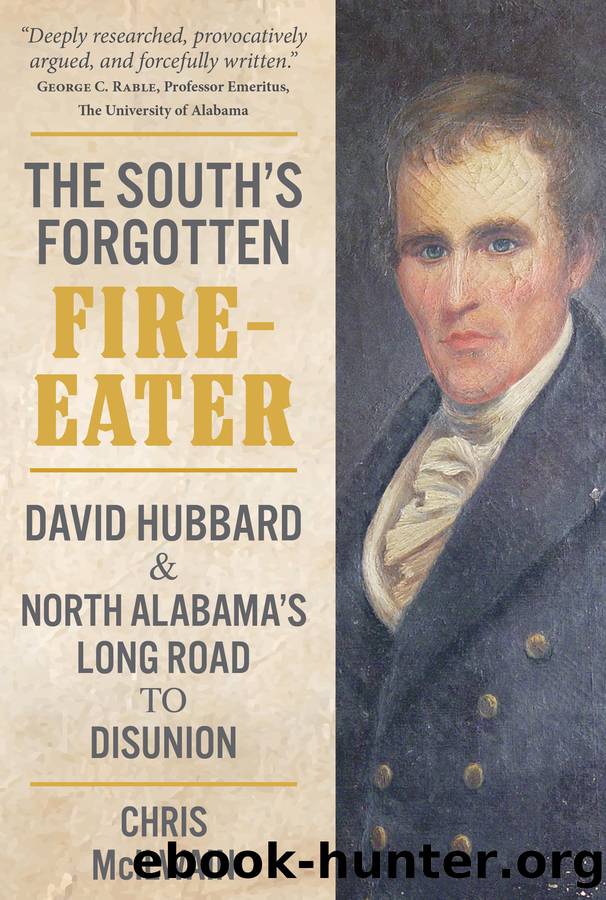
The South's Forgotten Fire-Eater by Chris McIlwain
Author:Chris McIlwain
Language: eng
Format: epub
ISBN: 9781588384126
Publisher: NewSouth Books
Published: 2020-11-09T00:00:00+00:00
12
The âViceregent of Old Fogy-Domâ
Not long after the 1851 election, Lawrence County residents wearied from the turmoil of this particularly heated political battle finally received the answer to their prayers for economic development. Word leaked that the board of directors of the Memphis and Charleston Railroad had officially decided to build that road south of the Tennessee River, rather than north, using the original right of way of the old TC&D.1 Although the 1850 federal census for Lawrence County had disclosed a paltry twenty-four manufacturing establishments, and a free population of only 8,406 (including sixty-three free blacks), boosters could now dream of a Northern-style quantum economic leap.2 Even Hubbard, now licking his electoral wounds, had something to rejoice given that the road would eventually pass through north Mississippi, making his remaining land there more attractive and valuable to planters.3
Despite repeated calls on stock subscribers to pay in their capital commitments, however, lack of money to construct the road was still a problem. The cost savings from selecting an acquired and already graded road bed probably explains in part why a âsouth sideâ route was selected using the TC&D right of way. Supporters of the Memphis and Charleston went to Montgomery intent on seeking financial aid, but the state remained in a shaky financial condition.4 In his message to the legislature, Governor Collier enthusiastically supported economic diversification, but recommended instead that Congress be petitioned to make land grants to assist construction of the roads.5
Moreover, the battle between Unionists and Southern Rights activists thought to have been decisively settled in the 1851 elections threatened to resume when Senator William Rufus King sought to lure Southern Rights Democrats back to the Democratic Party in preparation for the 1852 presidential election. This undermined the Unionist coalition and unwittingly further complicating mutual logrolling efforts by Whigs and Democrats in the legislature supportive of state aid for railroad construction.6 This controversy spilled into the debate over what was known as the âInternal Improvement Bill,â which would have provided aid for several railroad projects by permitting the state to guarantee corporate bonds to be issued and sold by the railroads, including those of the Memphis and Charleston.7 Tempers became so heated that a Lawrence County legislator introduced a bill to move the state capital from Montgomery to Selma.8 The railroad aid bill was ultimately killed in the house when a vote on its passage was indefinitely postponed.9
Railroad promoters throughout the state were stunned and frustrated by this turn of events, leading one newspaper correspondent to muse that although âSolomon says âin the multitude of counselors there is wisdomâ¦â this maxim, I opine, applies only to assemblages under the Jewish dispensation. Certainly, if the rule be general, the present General Assembly is an exception thereto.â10 No doubt many others had strong opinions about who ought to be the first inmates for the stateâs first insane asylum, which was authorized during this session.11
The upshot of divisive presidential politics was that neither the legislature nor Congress would be forthcoming any time soon with financial aid for railroad construction.
Download
This site does not store any files on its server. We only index and link to content provided by other sites. Please contact the content providers to delete copyright contents if any and email us, we'll remove relevant links or contents immediately.
| Africa | Americas |
| Arctic & Antarctica | Asia |
| Australia & Oceania | Europe |
| Middle East | Russia |
| United States | World |
| Ancient Civilizations | Military |
| Historical Study & Educational Resources |
The Dawn of Everything by David Graeber & David Wengrow(1764)
The Bomber Mafia by Malcolm Gladwell(1667)
Facing the Mountain by Daniel James Brown(1605)
Tip Top by Bill James(1495)
Submerged Prehistory by Benjamin Jonathan; & Clive Bonsall & Catriona Pickard & Anders Fischer(1494)
Wandering in Strange Lands by Morgan Jerkins(1485)
Driving While Brown: Sheriff Joe Arpaio Versus the Latino Resistance by Terry Greene Sterling & Jude Joffe-Block(1410)
Red Roulette : An Insider's Story of Wealth, Power, Corruption, and Vengeance in Today's China (9781982156176) by Shum Desmond(1396)
Evil Geniuses: The Unmaking of America: A Recent History by Kurt Andersen(1393)
The Way of Fire and Ice: The Living Tradition of Norse Paganism by Ryan Smith(1372)
American Kompromat by Craig Unger(1362)
F*cking History by The Captain(1353)
It Was All a Lie by Stuart Stevens;(1343)
American Dreams by Unknown(1320)
Treasure Islands: Tax Havens and the Men who Stole the World by Nicholas Shaxson(1307)
Evil Geniuses by Kurt Andersen(1299)
White House Inc. by Dan Alexander(1244)
The First Conspiracy by Brad Meltzer & Josh Mensch(1217)
The Fifteen Biggest Lies about the Economy: And Everything Else the Right Doesn't Want You to Know about Taxes, Jobs, and Corporate America by Joshua Holland(1159)
